Ticket prices are going up, again. It is understood that inflation is to blame. After all, the cost of everything is going up. Hockey fans are willing to pay more, within reason, to watch a competitive team with a chance of winning a championship. A connection is made between the price of admission and a team’s success in the standings.
These sentiments ring true today just as they did some 106 years ago when they were expressed in a letter to the editor of the Ottawa Citizen. Writing in 1920, Michael Moloughney, an avid Ottawa Senators fan, reminds us that the relationship between professional hockey teams and their fans was the same a century ago as it is today.
By 1920, the Ottawa Senators were a local institution with a proud history going back to the 1880s. An important contributor to the city’s identity, they strengthened residents’ sense of pride in their city and provided much needed entertainment during the long cold winters in the capital.
But the Senators were also a business with a bottom line. Icing a good team to play in an arena suitable for professional hockey required spending money. By 1920, the cost of operating a professional hockey team was rising faster than ever before attributable in large part to increasing player salaries. And salary increases were the result of there being three professional leagues vying for the best players: the National Hockey League (NHL), the Pacific Coast Hockey Association (PCHA), and the Western Canada Hockey League (WCHL).
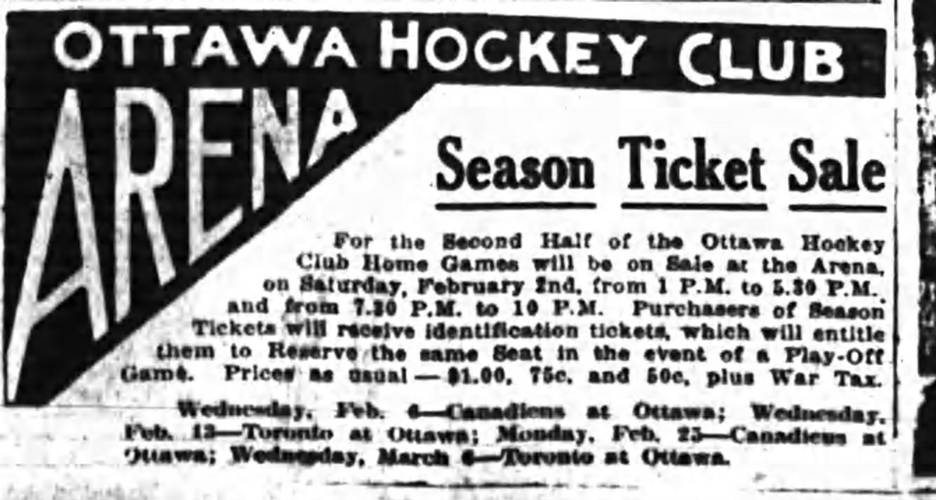
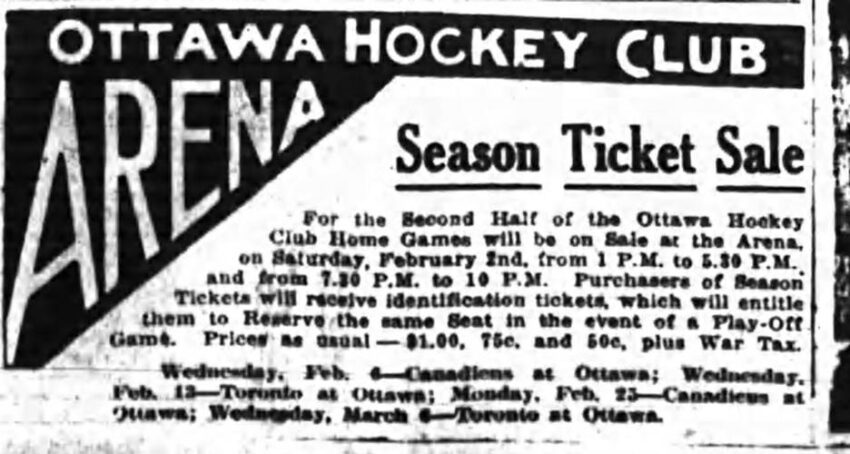
A February 1,1918 advertisement in the Ottawa Citizen showing game tickets ranging in price from .50 cents to $1.00.
In the early years of professional hockey in Ottawa fans could only follow their team in two ways: attend the games in person and/or read about them in the next day’s newspaper. The first time the Ottawa Senators were ever heard over the airwaves was on February 14,1923 when their game against the Toronto St. Patrick’s was broadcast live on radio from Toronto’s Mutual Arena (Arena Gardens).
But radio broadcasts of Senators’ games were by no means a regular occurrence as club ownership mostly resisted the medium for fear it would hurt ticket sales. The reality was ticket sales paid for player salaries as professional hockey was almost exclusively gate driven. It did not help that the team did not own their rink. They were renters and had to share some of the gate proceeds.
It was inevitable, then, that ticket prices would have to increase. If fans wanted to see a competitive Ottawa Senators team, they would have to pay. Here is what Michael J Moloughney had to say about this:
Pro. Hockey Prices (Ottawa Citizen, November 27, 1920)
Sporting Editor, Citizen: I glean from late editions of The Citizen that it is the intention of the Ottawa Hockey Club to this year make a further boost in their prices of admission. The references made in the Citizen are, I presume, gentle “feelers” but I am confident that the few remarks I am about to make will be heartily concurred in by the general sporting public of Ottawa.
In the war-time season 1917-18 the Toronto Blueshirts won the N.H. L. championship and later the world’s championship from Vancouver. Everyone knows of the disputes and wrangles that were (and still are) prevalent over the ownership of that club, which culminated in a number of court actions. In one of these suits it was disclosed that the net profits of the club that season were slightly in excess of $20,000. The N.H.L. that season consisted of Canadiens, Ottawa and Toronto. Therefore, every trip Toronto made was a long one, while the Ottawa club’s out-of-town expenses were considerably less in view of the fact that the Ottawa-Montreal route is a comparatively short one. Last season, however, the long trips to Quebec had to be made. Is there any reason to believe that the Ottawa Hockey Club’s net profits last season were not as much as that of the Toronto Club, namely $20,000? The Arena was packed to capacity almost every game; there was also the world’s series, which consisted of the full quota of games (not saying it wasn’t decided on its merits) and which drew three packed houses here and under the circumstances, two very large houses in Toronto. The Ottawa and Seatle clubs profited handsomely from the latter two games as they derived the full proceeds, after expenses and a small portion to the Arena Gardens were deducted.
A year ago, the prices were boosted, but only very slightly. This procedure was very acceptable to the public, in view of the general trend of upward prices. The club was a credit to the city, capturing both halves of the split season (which was, indeed, a testimonial to the honesty of the sport), and then climaxed the season by winning the highest honors in professional hockey. It is, therefore, natural that when the very best is provided no objection should be raised as to prices, provided they are kept within reason. But is there any guarantee that with prices increased this season, as we are led to believe, the club will win the title? And let me state here that should the club develop into a loser the box office will suffer.
It is well known that the hockey prices in Ottawa have always been lower than in Montreal or Toronto. I have attended games in both the latter places and know whereof I speak. But, to counterbalance this, I would point out that Ottawa fans patronize their club wonderfully whether it be a winner or not. Since 1911 only one championship was brought to Ottawa previous to last season, that in 1915, and then the club was hopelessly outclassed by Vancouver in the world’s series. During the war-time years of ’16 and ’19 the club was not what could be termed a winner, although it figured in playoffs with Canadiens in 1917 and 1919, yet the patronage at local games was remarkable. In Toronto or Montreal losing clubs don’t draw flies, consequently their prices are somewhat higher so that their good seasons counterbalance lean ones. It must also be remembered that Toronto is the most part an amateur hockey city, as both the Junior and Senior O.H.A., and particularly the latter, have a tremendous following.
In the United States several major league baseball clubs would be quite satisfied with a net profit of $20,000 on a whole season’s activities, and this is on a capitalization of $1,000,000 too. Not more than two major league franchises (including players) could be bought for less than that figure. Yet the Ottawa Hockey Club derived that revenue, perhaps even more, as it was a very lean year that the Toronto club cleared $20,000, in three months on a capitalization of one-twentieth as much.
With the prevailing cry of “Down with prices”, at the present, don’t you think it is rather an inappropriate time for a club to serve notice on its patrons of a large advance in prices? Last season, if I remember correctly, the prices were 30, 55, 85 cents and $1.25. I am informed that this year the rush-end price is to be 50 cents. Should such be correct it would mean an increase of 66 2-3 per cent. The Ottawa Hockey Club’s case is evidently the same as that of the rich man – “the more he gets the more he wants”.
I expect that on perusal of this article several cries of “Cheap skate”, etc., etc., will go up. However, no recognition of those need be taken. I have attended every match the past seven years when in Ottawa, also several in other cities and have never had cause to the present to complain of ill-treatment by any of the officers of the Ottawa Hockey Club. But several friends have this year casually remarked to me that another boost is totally unwarranted. I would strongly advise the proper officials to consider this matter very seriously before arriving at a definite conclusion.
Trusting I have not taken up too much space in your columns,
Yours very truly, MICHAEL J MOLOUGHNEY, 386 Slater street, Ottawa, Nov. 25.
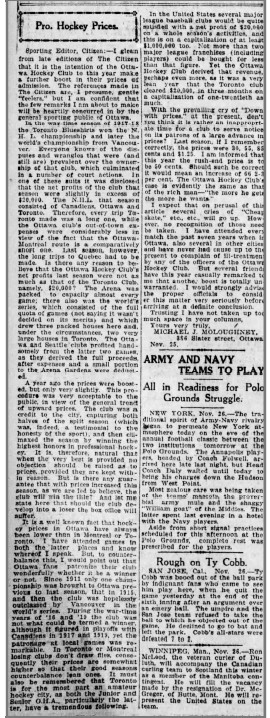
As it appeared in the Ottawa Citizen, 27 November, 1920.
Notes:
- “World series” was sometimes used to mean Stanley Cup Championship. While Ottawa was the 1919-20 champion of the National Hockey League, it still had to compete in a Stanley Cup Championship series against the top team from the Pacific Coast Hockey Association, the Seattle Metropolitans. Ottawa beat Seattle three games to two to win the series, the Stanley Cup, and the right to call themselves “world champions”. It was not until 1927 that the Stanley Cup became the championship trophy, exclusively, of the NHL.
- Due to melting ice at the Dey’s Arena, the last two games of the Seattle-Ottawa series, played on March 31 and April 1, 1920, were moved to Toronto’s Arena Gardens as it had refrigerated ice.
Sources:
Coleman, Charles. The Trail of the Stanley Cup. 3 vols. Montreal: National Hockey League, 1966-1977.
Kitchen, Paul. Win, Tie, Or Wrangle: The Inside Story of the Old Ottawa Senators, 1883-1935. Manotick: Penumbra Press, 2008.
“Ottawa Hockey Club Arena Season Ticket Sale”, The Ottawa Journal, 1 February 1918, page 10.
“Pro Hockey Prices”, The Ottawa Citizen, 27 November 1920, page 20.