Adapted from Chapter 14
They were the NHL’s powerhouse team of the 1920s. From the 1919-20 season through to 1926-27, the Ottawa Senators finished first in league standings six times and won four Stanley Cups. Such was their dominance, they were sometimes called the “Super Six”, an obvious play on their Silver Seven sobriquet from twenty years earlier.
Anchoring the Senators defence in 1919-20 were Sprague Cleghorn and Eddie Gerard along with up-and-comer Georges “Butch” Boucher. The forwards were Harry Broadbent, Morley Bruce, Jack MacKell, Horace Merril and the scoring trio of Cy Denneny, Jack Darragh, and Frank Nighbor. In goal was future Hall-of-Famer Clint Benedict.
Over 24 regular season games, Ottawa won 19 and lost 5. By finishing first in both halves of the schedule, the Senators won the NHL championship without the necessity of a playoff and thus the right to host the Pacific Coast Hockey Association champion Seattle Metropolitans for the 1920 Stanley Cup. The Senators were ahead two games to one when mild Ottawa temperatures turned the Dey’s Arena ice to slush. The series was moved to Toronto to take play on the artificial ice at the Mutual Street Arena. Seattle won game four by a score of 5 to 2 but the Senators bounced back in the deciding game five, winning 6 to 1 to take home the Stanley Cup, their first since 1911.
After another NHL first place finish in 1921, the Senators won their second of back-to-back Stanley Cups when they defeated the Vancouver Millionaires in a best-of-five series. Jack Darragh led the way with five goals including the game five winner. The entire series was played at the Denman Arena in Vancouver between March 21 and April 4 before 51,000 fans.
They were back again in 1923 to contest for the Cup, this time defeating the Edmonton Eskimos of the West Coast Hockey League, sweeping them in a best-of-three series. In the second game, Ottawa’s sensational sophomore Frank “King” Clancy played all six positions including goalie when Senator’s netminder Clint Benedict was serving a minor penalty for slashing. Clancy did not give up a goal. The series was played on the artificial ice at Vancouver’s Denman Arena on March 29 and 31.
Between 1924-25 and 1926-27, the Senators enjoyed the stability of a core of talented players surrounded by emerging new players in supporting roles. Alex Connell, the promising amateur goaltender succeeded Clint Benedict in Ottawa’s net. Frank Clancy had met and even exceeded management expectations and was now established as the team’s top defenceman. The club signed amateur Reginald “Hooley” Smith from the Olympic champion Toronto Granites in 1924, and he immediately won a starting position on right wing. At centre, as usual, was Frank Nighbor and on his left Cy Denneny. Frank Finnigan, the Ottawa Montagnard amateur, who signed with four games remaining in 1924, slowly came into his own, and, well established by his third season (1926-27), frequently started at right wing. Yet another graduate of the local amateur ranks, Hector Kilrea joined the Senators in 1925. A versatile player, he filled in capably at all three forward positions while earning a reputation as a first-rate professional.
After finishing first overall in 1925-6 season, the Senators were surprised by the Montreal Maroons in the playoffs but returned the next season looking for revenge. They finished 1926-27 with a record of 30 wins, 10 tosses and 4 ties. After defeating the Montreal Canadiens in the Canadian Division playoff, they faced the American Division champion Boston Bruins in what was the first ever all NHL Stanley Cup final. The Senators came out on top winning the best of five series 2 games to 0 on account that games one and two ended in ties (despite twenty-minute overtimes) reducing the series to a best of three.
The “Super Six” had won their fourth Stanley Cup in eight years and had reached the pinnacle of success. They were mostly a hometown lot with a full summer to bask in glory amidst a doting public. Not far from the minds of the players and their supporters, however, was the uneasy thought that all good things come to an end. As it turned out, it was the last Stanley Cup ever won by an Ottawa team.
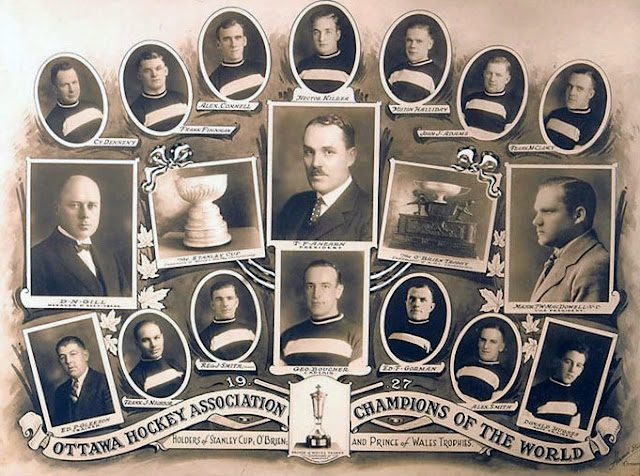
Team captain George Boucher, bottom centre, led the 1926-27 Senators to their last Stanley Cup. MCAULEY COLLECTION
Sources:
Coleman, Charles. The Trail of the Stanley Cup. 3 vols. Montreal: National Hockey League, 1966-1977.
Kitchen, Paul. Win, Tie, Or Wrangle: The Inside Story of the Old Ottawa Senators, 1883-1935. Manotick: Penumbra Press, 2008.
Zweig, Eric. Stanley Cup: The Complete History. Richmond Hill, Ontario: Firefly Books Ltd, 2018.