Adapted from Chapter 10
Half a world away from the hockey rinks of the capital, the 1st Canadian Division was preparing for battle. Ypres was the last remaining Belgian soil under allied control and the Canadians were about to enter the trenches in front of the town. Soon after the awful events of April 22, 1915, and over the weeks following, the public would learn of the horror. From a stockpile of iron cylinders, the Germans had released billowing clouds of sickly green chlorine gas. A light wind carried the deadly fumes over the Algerian and French defenders, forcing them to retreat. The Canadians moved in to close the gap but were driven back. Later, the Germans dispensed more gas, but the Canadians kept fighting and held the line. The cost of their success was appalling — over 6,000 dead and wounded during the month-long engagement. The news horrified Canada. Though far away, the war was now close to home.
If, for many of those who had enlisted, the war was expected to be a short adventure, for those still at home it was now clearly seen for what it really was, untold carnage and horror, with no end in sight. Clergymen, politicians and platform speakers and even hockey league executives urged young men to sign up. Captain James T. Sutherland, president of the Canadian Amateur Hockey Association and quartermaster of the 146th Overseas Battalion, called on the players’ sense of duty. “Exchange the stick and puck for a ‘Ross rifle and a bayonet,’ and take your place in the great army that is being forced to sweep the ‘oppressors of humanity’ from the face of the earth.”
But there were two schools of thought. Ottawa’s professional hockey team, like others, was needed, so the argument went, to keep spirits up during such dark times. At the same time, thousands of able young men were refusing to enlist, even when the shortage of troops was such that conscription was being talked of. These same young men were also the backbone of the Senators’ fan support. Without them, the viability of pro hockey would be doubtful.
So, the games went on. If there was any criticism of the professionals for continuing to ply their trade, it was muted. Certainly, as the war dragged on, attendance at Ottawa dates began a steady decline, but many people still did enjoy going to games and the important matches were sure to fill the arena.
The press’s daily listing of war dead and wounded brought home with painful regularity the magnitude of Canadian sacrifices at the front. Hardened though they had become to the scanning of these columns for familiar names, Ottawans were taken up short in September 1916 by one in particular. “Lieut. Frank McGee, son of Mr. and Mrs. John J. McGee, 185 Daly Avenue, has been killed in action in France,” reported the Ottawa Citizen. After having been wounded in a previous skirmish, McGee was with the 21st Division as a motorcycle dispatch rider when the Division joined the Battle of the Somme. At an undetermined moment on the afternoon of September 16, his life came to a sudden end. A stark note in a military file at Library and Archives Canada reads, “Body unrecovered for burial.”
Though retired from hockey, McGee was still beloved as one of Ottawa’s biggest sports stars ever and perhaps the greatest hockey player of his era, the one who led the Ottawa Hockey Club to its first Stanley Cup back in 1903. In 1914, at the age of 32, he enlisted to fight overseas. Two years later he was dead.
By the time of Frank McGee’s death, some seventy-five hockey players were among the three hundred Ottawa-area athletes in uniform. As for professional hockey, it struggled on in a climate of fear and apprehension, where any pretext of normalcy was welcomed.
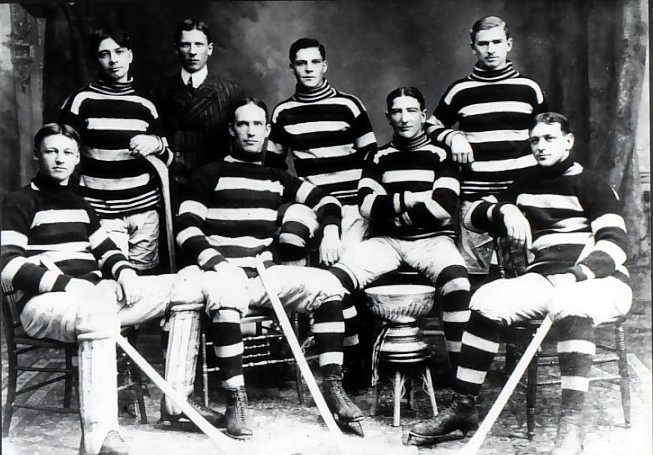
Frank McGee, standing at the back far right, posing with his teammates and the Stanley Cup in 1905. PHOTO: LIBRARY AND ARCHIVES CANADA PA91046
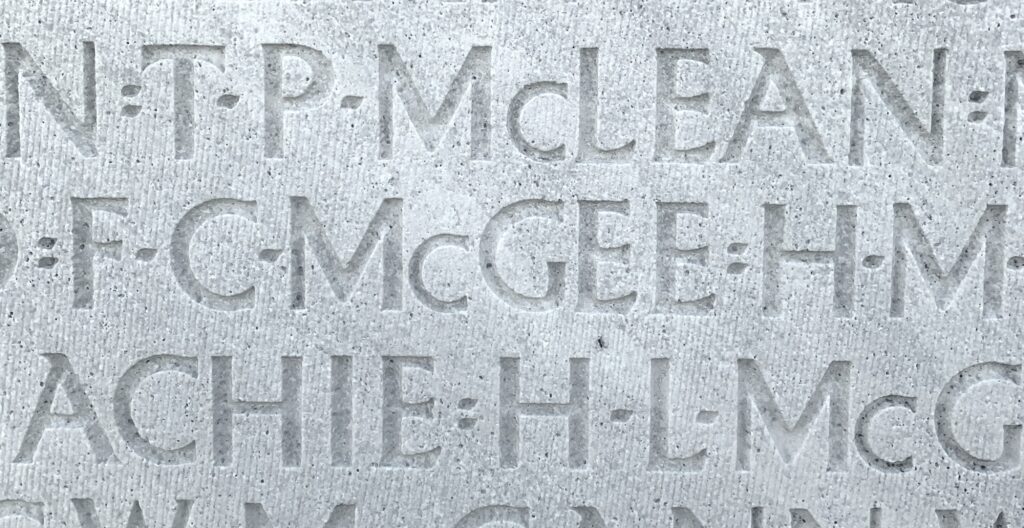
The name F.C. (Francis Clarence) McGee is one of 11,285 inscribed on the ramparts of the Canadian National Vimy Memorial in France. He is also commemorated on page 282 in the First World War Book of Remembrance, in Parliament’s Centre Block in Ottawa. In 1945, McGee was a posthumous inductee to the Hockey Hall of Fame, the first year it inducted members. IMAGE: PETER KITCHEN.
Source: Kitchen, Paul. Win, Tie, Or Wrangle: The Inside Story of the Old Ottawa Senators, 1883-1935. Manotick: Penumbra Press, 2008.