
Adapted from Chapter 10
As the Silver Seven era was ending so too was the sham of amateurism. It was an open secret that many of the better players were receiving pay in order to play. Newspapers ridiculed the deception. “Hockey and football players in Ottawa,” quipped the Toronto Telegram in 1906, “are to remain on the ‘old amateur playing status,’ which probably means that the club will make no attempt to cut salaries this year.” Looking back, an Ottawa Hockey Club executive recalled in 1909: “Ten years ago when the teams were supposed to be ‘simon pure’ it was considered good going if the clubs were able to hand each of the players $100 ‘on the side’ at the close of each season.” The annual stipend soon rose to $200, he said, and by the time the Ottawas won the Stanley Cup in 1903 “the men received something like $250 per season.”
For owners and players alike, however, the transition from amateurism to outright professionalism was a sticky issue. For one thing, the public was divided. Some detested the very idea of players receiving money for engaging in sporting activities while others were not against professionalism in sport. A complication was that some hockey players, like Harvey Pulford, excelled in other sports, in which they competed as amateurs. If they were uncovered as pros in hockey, they would be banned from amateur boxing, rowing, etc. It was therefore necessary for owners to hide their payments for fear that these athletes would stay away from hockey if their amateur status were to be put in jeopardy.
A compromise was reached. Teams were permitted to play both professionals and amateurs but had to submit to the league a list of all their players, showing who is pro and who is amateur. Still, there were many who resented professionalism in sport and many teams vowed to keep the league as free of professionals as possible. Though the Montreal Wanderers came right out and said they would play “at least one professional,” other clubs were non-committal about the proportions.
An issue with the compromise could have been the Stanley Cup. Shrewdly assessing these developments, the Stanley Cup’s trustees let it be known that in the trophy’s deed of gift there was no stipulation as to amateur standing. This meant teams in Canadian professional and amateur leagues could challenge for the vaunted symbol of hockey supremacy.
By 1909, Canada’s premier league, the Eastern Canada Hockey Association (ECHA) was entirely professional with four clubs: Ottawa, Montreal Wanderers, Quebec, and Montreal Shamrocks. But there were other leagues, professional and amateur, like the National Hockey Association (N.H.A), the Canadian Hockey Association (C.H.A), the Ontario Professional Hockey League (O.P.H.L), and the Pacific Coast Hockey Association (P.C.H.A) all vying for players. By 1911, there were only two professional leagues remaining, the N.H.A. and the P.C.H.A, but the inevitable salary war was about to begin.
Among those going west were the great Canadiens star Newsy Lalonde, Harry Hyland and Ernie Johnson of the Wanderers, Don Smith and Bobby Rowe from Renfrew, and Tommy Dunderdale and Ken Mallen from Quebec. Then in 1912, the biggest hockey star of all jumped to the P.C.H.A. One time Ottawa Silver Seven and now Renfrew Millionaires’ defenseman Frederick Wellington (Cyclone) Taylor left for the Vancouver Millionaires of the P.C.H.A. for a reported annual salary of $2,200 making him hockey’s highest paid player.
The consequences of Taylor’s defection to the western league were dire. One year after the inception of the rival P.C.H.A., player salaries for the Ottawas of the N.H.A. had doubled. Payroll inflation had a devastating effect on the bottom line, for in spite of healthy ticket revenues of $16,344.25, the club’s expenses (including $5,770.15 to rent Dey’s Arena) totaled $20,214.91—an operating loss of $3,870.66. In just under thirty years, hockey had evolved from amateur sportsmen playing a game they loved to professional athletes playing for money. Hockey was on its way to becoming a commercial enterprise.
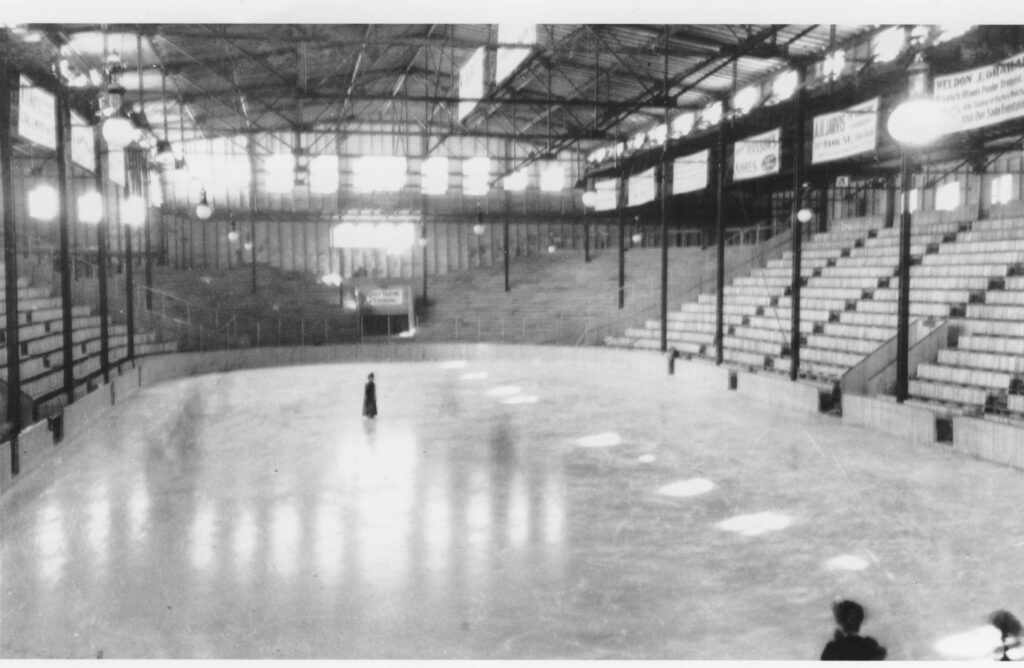
An interior view of the newly built Dey’s Arena on February 10,1908. With seating for 7,500, the spacious arena was a testament to hockey’s rise as a business. LIBRARY AND ARCHIVES CANADA PA203558
Source: Kitchen, Paul. Win, Tie, Or Wrangle: The Inside Story of the Old Ottawa Senators, 1883-1935. Manotick: Penumbra Press, 2008.