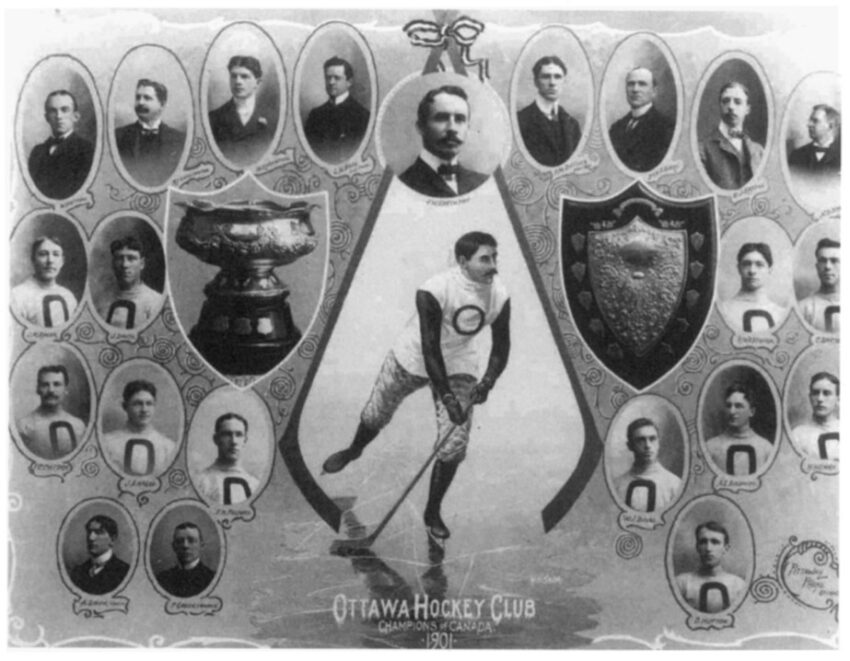
The Ottawa Hockey Club, the Ottawas, the Silver Seven, and the Senators were all one in the same.
The Ottawa Hockey Club was organized to play what was becoming the increasingly popular game of hockey in 1883. Its original members assembled to play the game among themselves just for the fun of it, while at the same time aspiring through a representative team to challenge outside clubs. According to one of its founders, Henry Ami, the club was a way for good exercise, good sport, lively games played in the amateur spirit, and to win – for the sake of the club and the city it represented.
By 1891, the Ottawa Hockey Club, always on the look out for competition, found itself in three leagues: The Amateur Hockey Association of Canada (AHAC) with games mostly played in Montreal, the Ontario Hockey Association (OHA) with games against the likes of Queens, Royal Military College, Osgoode Hall, and the Victorias of Montreal, and in an Ottawa city league against Ottawa College, Dey’s Rink (who played their games at the Dey’s arena), and the Gladstones. The Ottawa Hockey Club played as the Ottawas.
In the last years of the 19th century, the Ottawas were not the only hockey team in the city vying for players, attention, and spectators as junior, intermediate, and senior teams like the Capitals, the Aberdeens, the Rebels, and the Electrics came into being. Names to differentiate the teams were becoming important.
The nickname Silver Seven was occasionally applied by newspapers to refer specifically to the 1903 to 1906 Ottawa Hockey Club teams as it was known that players were given silver nuggets, by mining magnate and club president Bob Shillington, as reward for their run of Stanley Cup victories. Outside Ottawa, the name Silver Seven was virtually unknown. In Ottawa, the name Senators was occasionally seen or heard, but mostly, they were simply the Ottawas.
The Ottawa Hockey Club officially assumed the name Senators when they transitioned into a professional team in a new professional league, the Eastern Canada Hockey Association (ECHA) in 1909. Interestingly, this did not mean that they were exclusively called the Senators by media or fans. In fact, even through the 1920s the Ottawa Citizen sometimes referred to the team as the “Ottawa Hockey Club”, “Ottawas”, and/or the “Senators” in the very same news story.
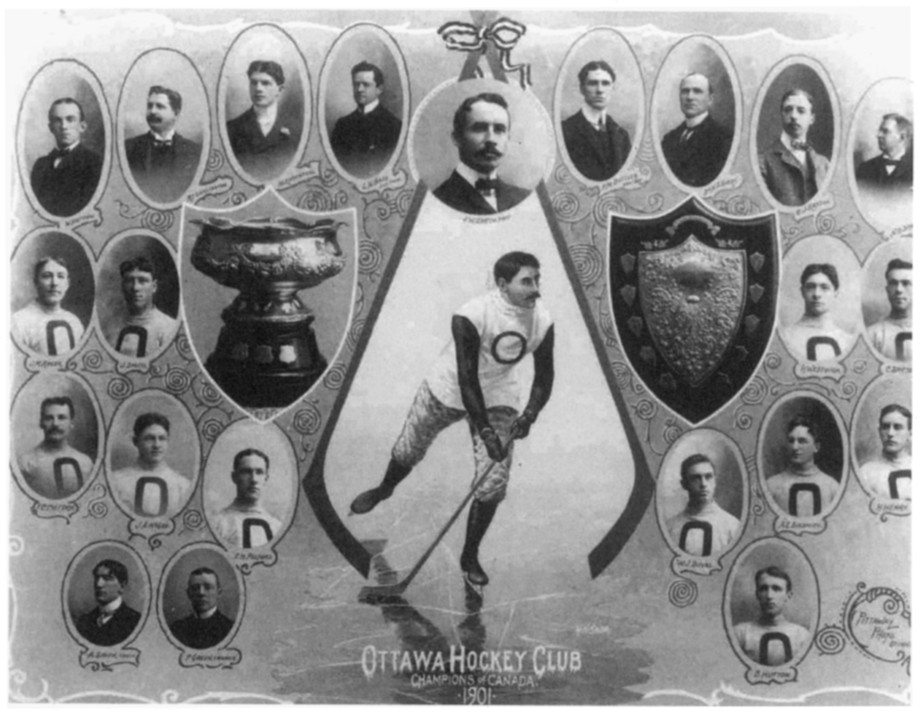
A plain “O” on their white jerseys was enough to identify the championship winning Ottawas of 1901. LIBRARY AND ARCHIVES CANADA C34882
An Interesting Aside: For a period in 1920s, the Ottawa Football Club, in existence since 1876 and playing mostly as the Rough Riders, adopted the nickname Senators hoping to inspire the same success as the hockey team. It paid off as the football Senators won Ottawa’s first Grey Cup in 1925. And in case you are wondering, “rough riders” was first used as a slur by a Hamilton newspaper critical of the Ottawa players’ aggressive style. So enamored were they of the “rough riders” label, the Ottawa Football Club happily accepted the insult as the club’s official nickname.
Sources:
Kitchen, Paul. Win, Tie, Or Wrangle: The Inside Story of the Old Ottawa Senators, 1883-1935. Manotick: Penumbra Press, 2008.
McAuley, Jim. Inside the Huddle: Rough Riders to Redblacks. (John Ruddy).
“Ottawa Senators work out over splendid sheet of ice”, Ottawa Citizen, Tuesday, November 11, 1924: https://www.newspapers.com/image/456687143/?match=1&terms=Ottawa%20Senators%20%20