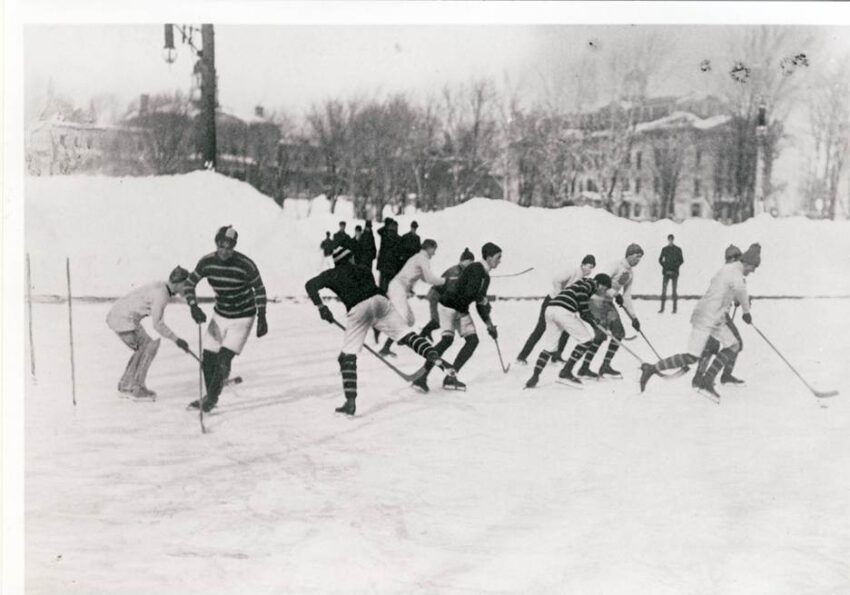
Early matches of hockey were adaptations from the rules of the English game of field hockey. Play started and was renewed after each game, with a “Bully in the centre of the ground”. In the bully, the opposing centres banged their sticks together before trying to gain possession of the “ball”, or puck, positioned between them.
The early rules said nothing of the number of players on a side. The players used spring skates but had no protective equipment. They wore colourful jerseys or white shirts with smart sashes. Their sticks, short and blunt-bladed, were imported from Halifax. The object of their attention progressed from a ball to a flat block of wood, to a square puck cut from a rubber ball and finally to the conventional vulcanized rubber disk of today.
The evolution of the puck from ball to disk is explained by the fact that the ice surface in the first covered rinks was not enclosed by boards. Spectators stood on concourses raised a few inches above the rink and ran the risk of being hit by a flying ball. It was reasoned that if the puck were flat it would not soar out of play.
In 1893, the Ottawa Hockey Club joined the Amateur Hockey Association of Canada (AHAC) that already had one team from Quebec City and three from Montreal; Montreal Amateur Athletic Association, the Victoria Hockey Club, and the Crystal Hockey Club.
Organized teams in an organized league required a common understanding of how to play the game and hence the AHAC rules of hockey were formally adopted on December 8, 1886:
The captains of contesting teams shall agree upon two umpires (one to be stationed at each goal) and a referee.
All questions as to games shall be settled by the referee, and his decisions shall be final.
All disputes on the ice shall be settled by the referee, and his decisions shall be final.
The game shall be commenced and renewed by a bully in the centre of the rink. Goals, six feet wide and four feet high, which shall be changed after each game, unless otherwise agreed.
When a player hits the puck, anyone of the same side who at such moment of hitting is nearer the opponent’s goal line is out of play, and may not touch the puck himself, or in any way whatever prevent any other player from doing so until the puck has been played. A player must be on his side of the ball.
The puck may be stopped, but not carried or knocked on, by any part of the body. No player shall raise his stick above his shoulder. Charging from behind, tripping, collaring, kicking or shinning, shall not be allowed, and any player after having been twice warned by the referee, it shall become his duty to rule the player off the ice for the match.
When the puck gets off the ice behind the goals it shall be taken by the referee at five yards at right angles from the goal line and there faced.
The goal keeper must not, during the play, lie, kneel or sit upon the ice, but must maintain a standing position.
Hockey sticks shall not be more than three inches wide at any part.
Goals shall be scored when the puck shall have passed between the goal posts and below the top and passed from in front below an imaginary line across the top of the posts.
The puck must be made of vulcanized rubber, one inch thick all through, and three inches in diameter.
A team shall be composed of seven players, who shall be bona fide members of the club they represent. No player shall be allowed to play on more than one team during a season except in a case of bona fide change of residence.
Two half hours with an intermission of ten minutes between will be time allowed for the matches. A match will be decided by the team winning the greatest number of games during that time. In case of a tie after playing the specified two half hours, play will continue until one side secures a game, unless otherwise agreed upon between the captains before the match.
No change of players must be made after a match has commenced except for reason of accidents or injury during the game.
Should any player be injured during a match and compelled to leave the field his side shall have the option of putting on a spare man from the reserve to equalize the teams; in the event of any dispute between the captains as to the injured player’s fitness to continue the game the matter shall be at once decided by the referee.
Should a game be temporarily stopped by the infringement of any of he rules the puck shall be brought back and a bully shall take place.
Today’s game owes many of its rules to those of 1886. It was an on-side game. “When a player hits the ball, anyone of the same side who at such moment of hitting is nearer to the opponents’ goal line is out of play and may not touch the ball himself”.
Players changed ends after each goal, called a “game”. Play was started, and renewed after each game, with a “Bully in the centre of the ground” – what we know today as a faceoff.
The penalty for an infringement of the rules, such as charging, tripping, collaring or kicking, was simply a cessation of play and a new bully.
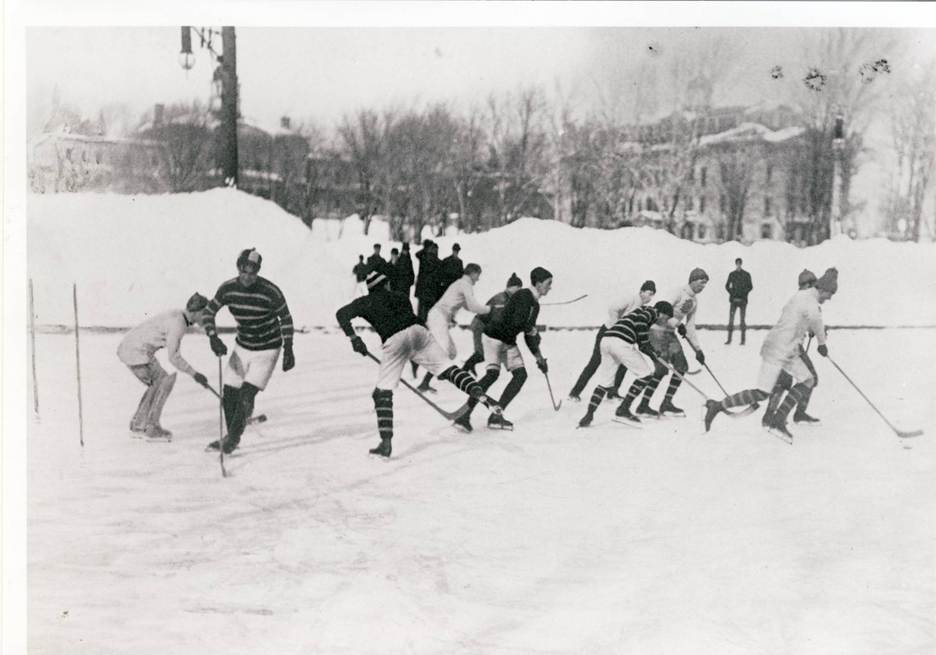
A hockey game at the outdoor rink on the McGill campus, circa 1884. Note the crouching goalie in front of two goal (poles) posts at far left and all players using short blunt-bladed sticks. LIBRARY AND ARCHIVES CANADA C17831
An Interesting Aside: It was also agreed at the AHAC meeting of December 8, 1886, that the hockey season be January 1 to March 15 as, of course, games were played outdoors and dependent on climate and weather.
Source: Kitchen, Paul. Win, Tie, Or Wrangle: The Inside Story of the Old Ottawa Senators, 1883-1935. Manotick: Penumbra Press, 2008.